So, here is the thing about Mint Tea. Everyone calls it tea, but if you want to be annoying at a dinner party, you can correct them: it’s actually a tisane or an herbal infusion. Real tea comes from the Camellia sinensis plant (you know, black, green, oolong), while mint tea is basically just hot water bullying the oils out of leaves. No caffeine, just vibes.Most of the time, what you are drinking is derived from the Lamiaceae family. Specifically, Mentha spicata, which is the fancy Latin name for Spearmint. That’s the OG variety, probably the oldest one we know of. It’s been hanging around the Mediterranean basin for centuries before spreading everywhere else. And it does spread. Like, aggressively. If you planted it in a garden in USDA zone 5 back in ‘98 without a container, you’re probably still fighting it today. It travels via underground rhizomes—creeping rootstalks—and just takes over.There’s also Peppermint (Mentha × piperita), which isn’t a purebred. It’s a hybrid child of spearmint and water mint (M. aquatica). The chemistry is different here.This is where it gets into the invisible stuff. The reason mint tea hits you in the nose before you even taste it is the volatile oils. We’re talking about active compounds. In peppermint, the big boss is menthol. That’s the cooling sensation, the stuff that wakes up your brain or makes your toothpaste burn. Spearmint is softer, sweeter. It doesn’t rely on menthol; its main players are carvone and limonene. Limonene is weirdly common, found in citrus peels too, but here it defines that specific “minty” profile that isn’t sharp like peppermint.Physically, if you look at the plant before it’s dried and shoved into a bag, it has these square stems. Seriously, roll a mint stem between your fingers—it’s square. A dead giveaway for the Lamiaceae family. The leaves (lance-shaped, usually) contain these tiny oil glands. When you pour boiling water over fresh or dried leaves, those glands burst. That’s the mechanism.It is simple stuff. Just leaves (maybe from the Kentucky Colonel variety if you’re fancy) and water. No fermentation, no oxidation like black tea. Just extraction. Some 19th-century botanists noted it growing wild near Baltimore, probably escaped from a kitchen garden. It’s just persistent like that.
Look, nobody really drinks mint tea just because they love the taste of warm toothpaste. Usually, there is a reason, and that reason is often located somewhere in the lower abdomen. It’s the “I ate too much cheese” remedy.Here is the mechanism, stripped of the marketing fluff: the active compounds in the leaves act as an antispasmodic.This is important. Your gastrointestinal tract is lined with smooth muscle. You can’t flex these muscles in the mirror, they just do their own thing, and sometimes what they want to do is cramp up and make you miserable. The oils in the tea—specifically the menthol if we are talking peppermint, though spearmint does a similar job—hit those walls and tell them to chill out. It literally relaxes the tissue. This allows gas (let’s just be real, it’s gas) to pass through more easily instead of getting trapped in a painful pocket near your ribs.If you have ever felt like an inflated balloon after a Thanksgiving dinner—let’s say it was 2014, and you definitely shouldn’t have had that third slice of pecan pie—this is the relief valve. It tackles bloating and abdominal pain by stopping the spasms. It’s not instant, obviously. You have to sit there, holding the warm mug, regretting your life choices for about 15 minutes. But it works.Then there is the Traditional Chinese Medicine (TCM) angle, which is fascinating because it sounds counterintuitive.In TCM, mint isn’t just about digestion in a mechanical sense; it is about “clearing heat.” They use it to reduce internal heat, especially during the summer. It sounds weird to drink hot water when it’s 95 degrees outside in mid-July, but the idea is that it promotes sweating and cools the body from the core. It also stimulates appetite. You know that feeling when it’s so hot you can’t look at food? The tea is supposed to fix that. It wakes up the stomach.So, it’s a bit of a contradiction. It relaxes the gut to stop pain, but stimulates it to make you hungry. Bodies are weird. But if it keeps the bloating down, most people aren’t going to argue with the logic.
Okay, let’s talk about the spearmint thing. If you’ve spent any time on hormone-health Reddit threads or deep-dived into PCOS forums around 2015, you’ve seen the hype. But unlike most “miracle cures” sold on Instagram, this one actually has some legs.The big deal here is that spearmint tea—specifically Mentha spicata, not the peppermint stuff you drink when your stomach hurts—acts as an anti-androgen.Here is the science, stripped of the jargon: it lowers free testosterone in the blood. High testosterone is usually the culprit behind the worst PCOS symptoms (acne, rage, hair loss). A study came out of Turkey a while back—I think it was a 30-day trial?—showing that drinking this stuff twice a day actually moved the needle on androgen levels. It’s wild that a leaf can do that. It’s not going to replace medication for everyone, but the data is there.For PCOS management, it’s often labeled as “adjunctive therapy.” That’s doctor-speak for “do this alongside the other stuff.”The mechanism involves tweaking the balance. While it pushes testosterone down, it potentially increases Follicle-Stimulating Hormone (FSH). Hormones are like a terrible, delicate orchestra; if the percussion is too loud, you can’t hear the strings. Spearmint tries to quiet the percussion (testosterone) so the strings (FSH/LH balance) can actually play the song. It’s an attempt to restore ovulation cycles that have gone MIA.Then there is the hair issue. Hirsutism.Let’s be real, this is the symptom people hate the most. Plucking chin hairs in the rearview mirror of a Honda Civic before work isn’t the vibe anyone wants. Because of those hormonal regulating effects I just mentioned, regular consumption of spearmint tea helps manage unwanted hair growth.Note that I said manage, not erase. It’s not a laser. It won’t make the hair fall out overnight. But the research suggests that drinking two cups a day—consistency is key here, you can’t skip a week—reduces the density and speed of growth. It slows the tide.It’s definitely a long game, though. You aren’t going to see results in a week. But for a cheap tea bag? Worth a shot.
So, let’s talk about what happens when you actually drink the stuff. Beyond the taste—which, let’s be honest, reminds everyone of that chewing gum you bought at a gas station in 2009—there is legitimate biology happening here.First off, the respiratory bit. If you’ve ever had a cold that settles in your chest like a concrete block, you know the vibe. Spearmint tea works as a respiratory aid, mostly because of the menthol content (though spearmint has less menthol than peppermint, it’s still doing the heavy lifting). It helps relieve nasal congestion pretty effectively. It’s not Sudafed, obviously. It’s a leaf. But the steam combined with the volatile oils helps open up the passageways. It also soothes throat discomfort. There’s an anti-inflammatory action that calms down that raw, scratchy feeling you get after coughing for three days straight. My grandmother used to swear by this—she’d brew a pot in her frantic little kitchen in Ohio whenever anyone sneezed—and she wasn’t wrong.Then there is the brain stuff. The cognitive boost.This is where it gets interesting, and honestly, a bit weird. Most people drink tea to relax, but the compounds in spearmint, specifically the menthol and limonene, actually stimulate the central nervous system (CNS). It’s not a caffeine jitter; it’s different. Research—mostly preliminary, don’t get too excited—suggests it enhances alertness and focus. There was this study I read a while back (maybe 2018?) suggesting it improves working memory. Like, helping you remember why you walked into the kitchen. It wakes up the brain without the crash you get from a double-shot latte at 2 PM.Lastly, pain reduction. It acts as a mild analgesic. Emphasis on mild—if you have a migraine that feels like an ice pick, call a doctor. But for tension headaches? It helps. It’s also surprisingly good for oral health issues because of those anti-inflammatory benefits. If your gums are angry or you have minor mouth irritation, swishing the tea (cooled down, obviously) can actually help. It’s nature’s mouthwash, basically. Just don’t add sugar if you’re doing that. Defeats the purpose.
It’s mostly about the knees. You know that specific, grinding stiffness that hits around late November when the damp sets in? My neighbor, Mrs. Gable, always claims she can predict the rain with her left knee, and honestly, she’s right about 80% of the time. But regarding the tea—the science is actually pretty specific here. It’s not magic; it’s chemistry.Studies looking into osteoarthritis have flagged spearmint tea as a legitimate way to alleviate joint pain. We aren’t talking about a total cure—if your cartilage is gone, it’s gone—but for the stiffness and the functional pain, specifically in the knees, the data looks good. It comes down to the rosmarinic acid and the antioxidants fighting the inflammation at a cellular level.Here is the catch, though. And it’s a big one.You can’t just have a cup on a Sunday and expect to run a marathon on Monday. The clinical observations that showed real results required patience. The effective dose was two cups daily, which doesn’t sound like much until you have to do it every single day. The study duration? Four months. Sixteen weeks. Most people I know quit their New Year’s resolutions by January 12th. Sticking to a tea regimen for a third of a year is a commitment. But the subjects who actually did it showed significantly improved stiffness scores compared to the control group. It builds up in the system. It’s not just the hard joints, either. The anti-inflammatory effect seems to work well on “wet” tissues. General inflammation. Think about when you have a sore throat that isn’t quite a cold yet, or that throbbing pain in your gums after you floss too hard (or when you accidentally bite your cheek eating pizza too fast). The cooled tea acts as a rinse. It soothes the local inflammation in the mouth and throat pretty quickly.So, is it effective? Yes. But it’s a slow burn. It’s a lifestyle adjustment, not an ibuprofen pill you pop and forget about. You’re playing the long game here.
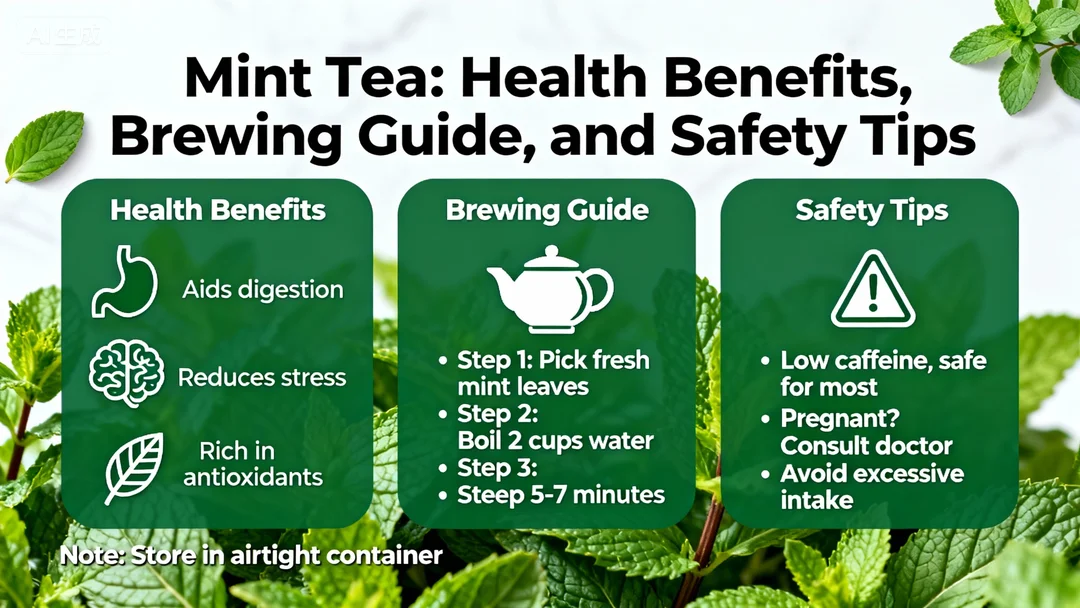
Honestly, most people ruin it immediately. They treat it like a Lipton bag they found in the back of the pantry from 2014. But if you actually want to extract the medicinal stuff—the oils, the flavor—you have to pay attention to the math.It starts with the green stuff. The golden ratio, according to pretty much every barista and grandmother worth their salt, is 5 to 8 fresh mint leaves per cup. That’s the standard. But let’s be real for a second—are we talking about those massive, prehistoric-looking leaves from a ‘Kentucky Colonel’ plant growing in the shade, or the sad, tiny ones from a plastic grocery store clam-shell? Use your judgment. If they’re small, throw in ten. Who cares. If you are stuck using the dried stuff because it’s December and everything in the garden is dead, the measure is 1 teaspoon. Don’t heap it. Dried mint is concentrated; it’s aggressive. Too much and it tastes like toothpaste.Once the leaves are in the mug—ceramic holds heat better than glass, just saying—you pour hot water over them. Not boiling. If the water is screaming hot, you just cook the leaves. You want to coax the flavor out, not murder it.Then, the hardest part: doing absolutely nothing.You have to let it steep for 3 to 5 minutes. This isn’t just arbitrary timing. You’re waiting for the volatile oils to release into the water. That’s the science bit. Menthol, carvone, limonene—they need a minute to wake up. If you drink it at minute two, it’s just hot water with a garnish. If you wait ten minutes, it gets weirdly bitter. Set a timer on your phone.Finally, the fixings. Purists will say drink it straight, but purists are often unhappy people. A lot of recipes suggest you add rock sugar or honey. Rock sugar is traditional—it looks nice, those jagged little crystals clinking against the spoon—but it takes forever to dissolve. You’re sitting there stirring like a maniac while the tea gets cold. Honey is easier, smoother. It coats the throat better, especially if you’re drinking this because you feel a cold coming on. Just don’t overdo it, or you lose the mint entirely.
Look, everybody treats mint like it’s this harmless, magical leaf that fixes everything. Stomach hurt? Drink mint. Headache? Mint. But it acts innocent until it isn’t.The big irony here—and I saw this happen to my cousin Dave back in 2012 after he ate way too many spicy wings at a bar in Chicago—is that the very thing meant to soothe your gut can actually light a fire in your chest. If you deal with acid reflux (GERD) or have stomach ulcers, you need to be really, really careful. Here’s the mechanism, stripped of the medical jargon: mint relaxes muscles. That’s why it feels good when you’re cramped. But it also relaxes the esophageal sphincter. That’s the little valve keeping your stomach acid down. When mint makes that valve lazy, the acid creeps up. It literally opens the door for heartburn. Dave drank a gallon of the stuff thinking he was “detoxing” and ended up sleeping sitting up for three days.Also, dosage. We have this “more is better” mentality. It’s annoying. People think because it’s a plant, they can chug it. Wrong. The general recommendation is to limit yourself to 1–2 cups per day. That’s the ceiling. The volatile oils in mint—menthol, mostly—are strong. If you drink liters of it, you risk irritation of the oral mucosa (your mouth feels raw) or actually upsetting your gut lining. It goes from soothing to scraping pretty fast.Then there are the specific warnings that nobody reads on the box. Pregnant women fall into the gray area. It’s usually fine? Maybe? But because it relaxes muscles (uterus included, theoretically), the standard advice is to consult a doctor before making it a daily habit. Better safe than sorry.And if you listen to the Traditional Chinese Medicine (TCM) crowd—my acupuncturist won’t shut up about this—people with a “cold” body constitution should avoid it. You know the type. Pale, always freezing, wearing a scarf in August. Mint is “cooling” energy. If you’re already an ice cube, don’t drink liquid nitrogen. It just makes sense.
- What are the top health benefits of drinking mint tea?
Mint tea is renowned for its digestive aids, ability to relieve tension headaches, and immune-boosting properties. It is rich in antioxidants and menthol, which can help reduce inflammation, soothe an upset stomach, and improve mental focus. - Is mint tea naturally caffeine-free?
Yes, pure herbal mint tea (made from peppermint or spearmint leaves) is naturally caffeine-free. This makes it an excellent beverage choice for those sensitive to caffeine or looking for a relaxing drink before bedtime. - How do you brew the perfect cup of fresh mint tea?
To brew fresh mint tea, wash a handful of fresh mint leaves and tear them slightly to release the oils. Place them in a cup, pour boiling water over them, and let steep for 5-10 minutes. You can add honey or lemon for extra flavor. - Can peppermint tea help with bloating and IBS?
Absolutely. Peppermint tea contains menthol, which acts as a natural antispasmodic. It helps relax the muscles of the digestive tract, effectively reducing bloating, gas, and cramping often associated with Irritable Bowel Syndrome (IBS). - Does drinking mint tea help with weight loss?
Mint tea can support weight loss efforts as it is calorie-free and can help suppress appetite. The scent of mint has been shown to reduce cravings, and replacing sugary drinks with unsweetened mint tea reduces overall calorie intake. - What is the difference between peppermint and spearmint tea?
Peppermint contains a higher concentration of menthol, giving it a stronger, cooling “minty” kick and making it better for digestion. Spearmint has less menthol, offering a sweeter, milder flavor, and is often cited for helping balance hormones. - Is it safe to drink mint tea during pregnancy?
generally, drinking 1-2 cups of mint tea is considered safe during pregnancy and can help with morning sickness. However, women with a history of miscarriage or those taking specific medications should consult their doctor first, as large amounts may trigger uterine contractions. - Can mint tea help clear a stuffy nose or sore throat?
Yes, the menthol in mint tea works as a natural decongestant. Breathing in the steam from a hot cup of mint tea can help break up mucus and clear nasal passages, while the warm liquid soothes a sore throat. - Are there any side effects to drinking too much mint tea?
While generally safe, consuming excessive amounts of mint tea can trigger acid reflux or GERD (Gastroesophageal Reflux Disease) in some individuals because it relaxes the sphincter muscle between the stomach and esophagus. - What is the best time of day to drink mint tea?
Because it is caffeine-free and aids digestion, the best times to drink mint tea are after meals to prevent bloating or in the evening to help relax the body and mind for better sleep.